
HR Isn’t a Department. It’s a Business Strategy.
For a long time, HR has been treated as the place you go when something has already gone wrong.
An employee files a complaint.
There’s conflict between team members.
A compliance question comes up.
Someone needs to be terminated.
A lawsuit suddenly feels possible.
Then HR gets the call.
And that is exactly the problem.
When HR only enters the conversation after something breaks, it becomes a department built around reaction.
At HRBoost, we believe HR belongs much earlier in the conversation.
Because HR isn’t simply a department inside the business.
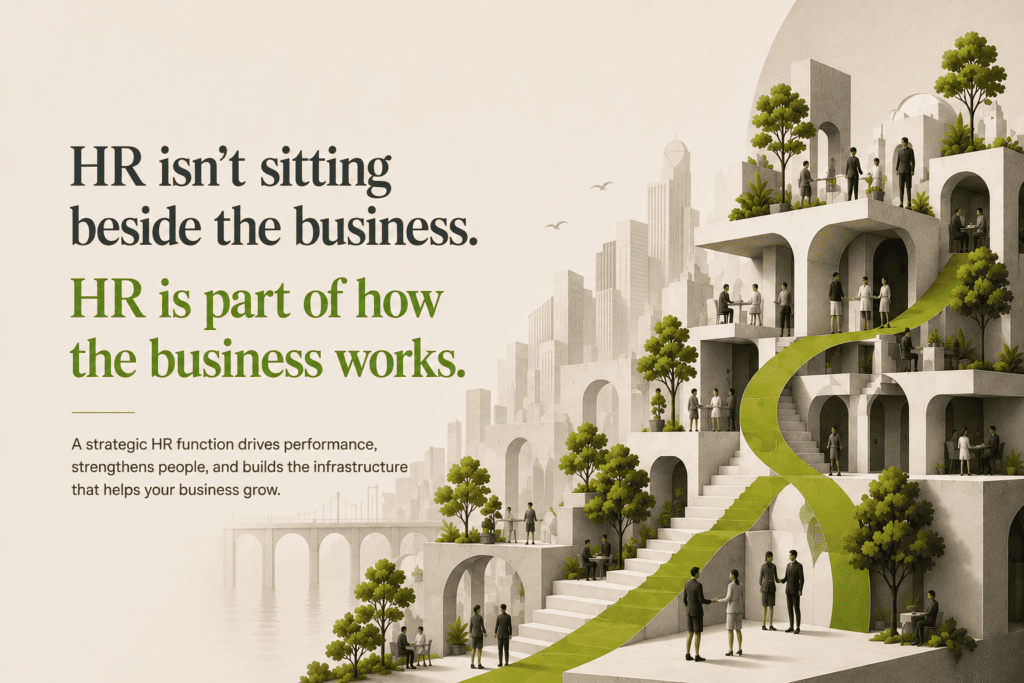
HR is part of the strategy of the business.
When HR only shows up for problems, it can only play defense.
The traditional view of HR tends to make it reactive.
There is a problem. HR responds.
There is a new regulation. HR updates the policy.
There is an employee issue. HR documents it.
There is a complaint. HR investigates.
Those things matter. Compliance matters. Policies matter. Documentation matters.
But if that is the only role HR plays, the business is leaving much of its value on the table.
Nicole Martin describes HRBoost’s approach differently. Instead of waiting for problems to happen, the goal is to build HR proactively and preventatively.
That means asking what needs to exist before the problem.
What expectations need to be clear?
What processes need to be established?
What does a growing team need from leadership?
What kind of culture is the founder creating?
What infrastructure will the organization need as it grows?
That is a very different version of HR.
It isn’t waiting for the fire alarm.
It’s helping design the building.
HR can be a profit center.
That might sound strange if you have always thought of HR as overhead.
But businesses don’t perform independently of their people.
People are how the business performs.
Your strategy can be brilliant on paper, but people still have to execute it.
People serve the customers.
People manage the processes.
People make decisions.
People solve problems.
People create the experience your customers associate with your company.
So when HR helps a business put the right people, processes, expectations, and conditions in place, it isn’t operating separately from business performance.
It is influencing business performance.
That is why Nicole argues that HR can be viewed as a profit center rather than simply an administrative cost.
Not because HR magically produces revenue on its own.
Because better people infrastructure supports the work that does.
The questions change when HR becomes strategic.
A reactive HR function asks:
What policy do we need?
Strategic HR asks something bigger:
What does this business need from its people to succeed?
That question opens several others.
Do people understand what they’re responsible for?
Are the right processes in place?
Do employees have what they need to do their best work?
Are roles clear?
Does leadership know what it expects from the team?
Can the organization add people without adding unnecessary chaos?
And perhaps most importantly:
Are we building the people infrastructure for the business we’re becoming, or only dealing with the problems of the business we have today?
Those aren’t administrative questions.
They’re business questions.
You don’t manage people. You manage the conditions around them.
There is another idea underneath this philosophy.
Businesses often talk about “managing people.”
But people aren’t machinery.
They make choices. They bring judgment, ambition, experience, personality, and their own motivations to work every day.
Leadership cannot control all of that.
What leadership can do is create better conditions for people to succeed.
Clear roles.
Useful processes.
Good communication.
Meaningful expectations.
Education.
Accountability.
A culture people actually understand.
This changes the role of HR again.
Instead of controlling people, HR helps the organization build the infrastructure around them.
And when that infrastructure is designed intentionally, people have a much better chance of doing great work.
HR should grow with the business.
There is no universal HR system that every company should download and install.
A five-person business does not have the same needs as a company with 50 employees.
A founder hiring their first employee faces different questions from a leadership team entering its next stage of growth.
That is why HR cannot simply be a PDF handbook sitting somewhere in a shared drive.
As the business changes, its people infrastructure has to change with it.
Roles evolve.
Responsibilities shift.
New layers of leadership appear.
Processes that worked with five people begin breaking with 25.
Culture becomes harder to transmit informally.
And decisions that once lived entirely inside the founder’s head have to become clearer to everyone else.
Strategic HR anticipates that evolution.
HR belongs inside the business.
This is ultimately the distinction.
HR shouldn’t be sitting on the edge of the organization, waiting for someone to bring it a problem.
It should be connected to where the company is going.
To growth.
To leadership.
To operations.
To culture.
To the people responsible for turning strategy into reality.
Because the people side of the business isn’t separate from the business.
It is the business at work.
And that is why we believe:
