
PEO Alternative for Small Business: What to Compare | HRBoost
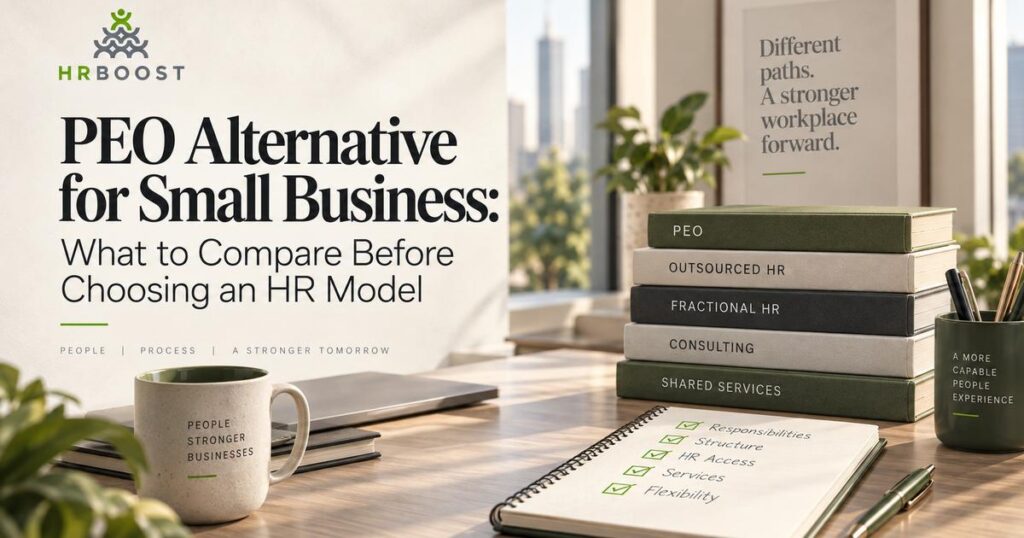
When a growing company begins exploring HR support, the number of available models can make the decision feel more complicated than expected.
PEO. Outsourced HR. Fractional HR. Consulting. Shared Services.
The terminology matters, but it should not be the first decision.
A more useful place to begin is with the work itself: which HR responsibilities does the organization need help carrying, and which responsibilities should remain inside the business?
That question creates a stronger foundation for evaluating a PEO alternative for small business or comparing HR outsourcing versus a PEO.
Understand What a PEO Is Designed to Provide
A Professional Employer Organization, or PEO, typically combines several employment-related services within one relationship.
Depending on the provider, that may include payroll administration, benefits, workers’ compensation support, HR technology, compliance assistance, and other HR services.
A defining feature of the PEO model is co-employment. Under that structure, the client company and PEO allocate certain employer responsibilities through their agreement while the client continues to direct its business operations and employees.
For some organizations, that structure and bundled support may align well with what the business needs. Other organizations may be looking for a different relationship.
What Can a PEO Alternative Look Like?
A PEO alternative may involve outsourced HR professionals supporting the organization without using the same co-employment structure.
The scope can vary. Some businesses need strategic HR guidance. Others need employee relations support, manager coaching, recruiting assistance, compliance support, process implementation, or recurring HR capacity.
HRBoost’s Shared Services approach is designed around HR expertise and implementation support, with services that can be structured to reflect the organization’s needs.
The useful comparison is not which label sounds better. It is whether the model aligns with the responsibilities the business needs help carrying.
1. Start With the Responsibilities
Before comparing providers, identify the HR work that currently requires the most attention. That may include:
- Payroll and benefits administration
- Employee relations
- Manager guidance
- Compliance
- Recruiting
- HR systems and processes
- Strategic HR planning
- Ongoing HR capacity
The list does not need to be long. It needs to be specific enough to show where the organization currently needs support.
This gives leadership a clearer way to evaluate whether a bundled model, an outsourced HR relationship, or another approach is more appropriate.
2. Understand the Employment Structure
One of the important distinctions in an HR outsourcing vs PEO comparison is the structure of the relationship.
A PEO uses a co-employment arrangement in which certain employer responsibilities are allocated between the PEO and client. Other outsourced HR models can provide HR expertise, guidance, and implementation support without using the same structure.
Leadership should understand that distinction before choosing a provider. Ask what the provider will own, what the business will continue to own, and how the arrangement will affect day-to-day HR administration and decision-making.
Clear expectations at the beginning support a stronger working relationship later.
3. Look at the HR Access You Are Buying
Two providers may both describe their offer as HR support and still provide very different experiences.
One model may focus heavily on administration and technology. Another may provide access to a consultant. Another may give the organization access to a broader team with different areas of HR expertise.
Consider what your managers and leaders will actually need. Who will they contact when an employee relations issue develops? Who will help implement a new process? Who will support managers when a policy needs to be applied in a real situation? How often will the provider engage with leadership?
Those answers help clarify what the relationship will feel like in practice.
4. Review What Is Included Together
Bundled services can be valuable when the organization genuinely needs those services together. The important step is understanding the bundle.
If the business needs payroll administration, benefits support, HR technology, and HR services through one model, a PEO may be worth considering.
If those administrative areas are already working well but the organization needs more HR expertise, manager guidance, employee relations support, or implementation capacity, another form of HR outsourcing services may align more closely with the need.
More services do not necessarily mean a closer fit. The more useful comparison is whether the services included align with the responsibilities your business actually needs support carrying.
5. Consider How the Relationship May Change as the Business Grows
HR needs rarely stay exactly the same.
A smaller organization may begin by needing foundational guidance and support. As the company grows, it may need more recurring capacity, stronger manager support, or additional HR expertise. Later, the business may build an internal HR team while continuing to use outside specialists.
That is why flexibility matters. When evaluating a provider, ask how the relationship can change as the organization changes. Can the scope expand or narrow? Can responsibilities shift between the internal team and outside partner? Can the provider work alongside internal HR when the business reaches that stage?
A thoughtful support structure should be able to evolve with the organization.
HR Outsourcing vs PEO: Focus on Fit
There is not one model that is right for every growing business. A better decision starts with understanding what the organization needs today and what it may need next.
- Which responsibilities need support?
- Which responsibilities should stay inside the business?
- How important are bundled administrative services?
- What kind of access do managers and leaders need?
- How much implementation support is required?
- How flexible should the relationship be as the organization grows?
Those questions make provider conversations more useful because they keep the discussion centered on the business rather than the label.
A Practical Next Step
Before requesting proposals, create two simple lists.
In the first, identify the HR responsibilities your organization would like help carrying. In the second, identify the responsibilities leadership wants to retain.
Then use those lists to compare structure, access, services, and flexibility across providers.
If you are considering a PEO or another outsourced HR model, HRBoost can help you think through the responsibilities and support structure that align with your organization.
The goal is a relationship that helps the business move forward with greater clarity, reliable HR support, and a model that can grow with the team.
